AEO vs SEO has become a buying question for B2B teams: should you spend time improving Google visibility, or try to become a source for AI-generated answers? In practice, a useful website needs clear information, accessible pages and evidence whichever discovery route brings the visitor.
Use AEO as a way to examine whether your content answers important questions clearly. Keep SEO as the wider work of helping relevant people discover and use the site. Neither label removes the need to explain your offer or earn trust.
Define the terms before buying a new programme
SEO covers work to improve a site's visibility and usefulness in search, including technical access, page structure, content and links. AEO, or answer engine optimisation, is commonly used for work intended to make information useful to answer-based experiences. Definitions vary between vendors.
Ask what a proposed AEO package actually delivers. Does it improve service pages, research customer questions, fix technical access or run a citation audit? A new label on a report does not establish a new mechanism or prove a business result.
For Google specifically, its AI-features guidance says existing SEO practices remain relevant and there are no special additional optimisations required for AI Overviews or AI Mode. That statement concerns Google's features; other products have their own systems and behaviours.
Start with the questions that precede a purchase
A B2B buyer may ask what a service includes, how platforms differ, what migration involves or who owns the website after launch. Those questions deserve useful pages because they help someone decide, regardless of whether an AI tool cites them.
Map each question to the appropriate destination. A comparison belongs on a comparison page. A scoped service belongs on a service page. A tutorial should teach a process and link to a relevant implementation route without pretending every reader needs to hire you.
Avoid generating dozens of near-identical answer pages. A clear guide with specific examples can be more useful than a library of short definitions that repeat the same sales paragraph.
Make answers specific and supportable
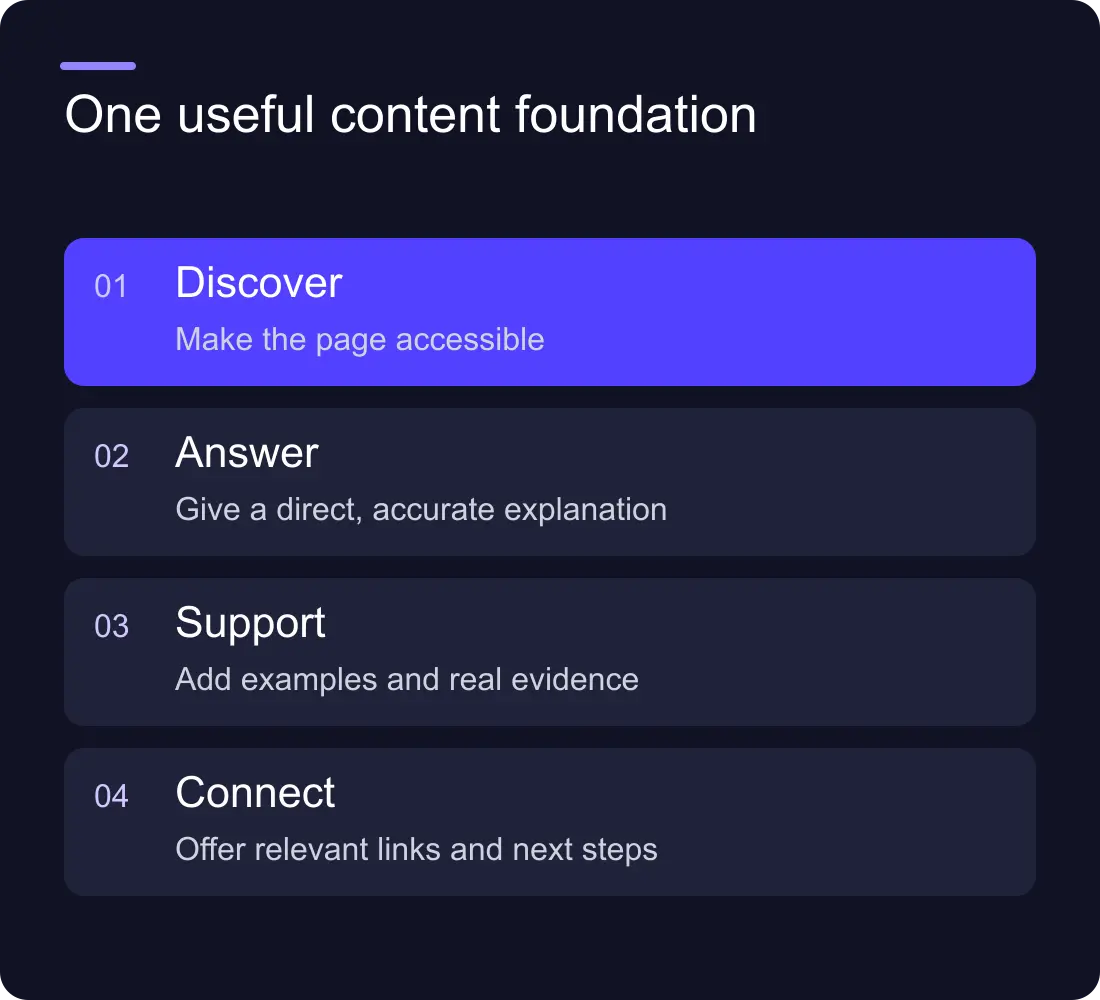
Put the answer near the question, then explain the conditions and trade-offs. If the answer is “it depends”, name what it depends on: catalogue requirements, content ownership, integrations or maintenance capacity.
Use genuine evidence. A project can demonstrate work actually delivered; it cannot support an unrelated performance claim. Vendor documentation can support a platform feature; it cannot prove that your agency will produce a particular revenue result.
For example, a website cost article should show which scope decisions change a quote. A migration guide should explain URLs, content and launch checks. These details are useful to people and make the content easier to assess as a source.
Keep access and structure in working order
Check that important pages are available, indexable where intended and linked from relevant pages. Confirm canonical URLs, metadata and sitemap entries. If a page redirects to the article hub instead of showing its body, rewriting the introductory answer will not fix the underlying problem.
Use headings that describe real sections. Mark up structured data only when it accurately represents the visible content. Do not add an impressive-looking schema block with information the visitor cannot see or verify.
Review website permissions and crawler controls separately from content quality. A policy decision about allowing a particular crawler should be deliberate and documented, rather than an accidental side effect of a plugin.
Measure visibility without inventing precision
Use search data for query-to-page changes and record meaningful conversions. For answer-engine checks, define the prompts, products, date and evaluation method. Save the actual answers and links so someone can inspect the result.
A citation in one test is an observation, not a stable market-share figure. Results can vary with the wording, system and context. Report those limits rather than turning a handful of prompts into a guaranteed visibility score.
Connect the reporting to the website's job. Did a visitor reach a relevant service? Was the enquiry suitable? Can the team see where it came from? A dashboard full of mentions is less useful if nobody can explain what action to take.
Choose work that improves both discovery and decisions
Begin with broken access, unclear core pages and missing evidence. Then improve the questions that customers repeatedly ask. Run bounded visibility checks to understand how different discovery products represent the business, and use the findings to identify real gaps.
This produces a concrete backlog: a better comparison, an accurate service explanation, a repaired sitemap or a clearer case study. It is easier to judge than a promise to “optimise for AI” without defined deliverables.
Does AEO replace SEO?
For a B2B website, keep the useful fundamentals and evaluate additional answer-engine work on its actual scope. Do not abandon existing search pages and measurement simply because a new discovery experience is growing.
Can an agency guarantee AI citations?
Ask for the precise product, prompt set, time period and evidence behind the claim. A responsible programme can improve content and monitor observations; it should not promise control over an external system's answers.
Explore Hilvy's SEO and conversion work or turn the findings into an AEO checklist for Webflow.