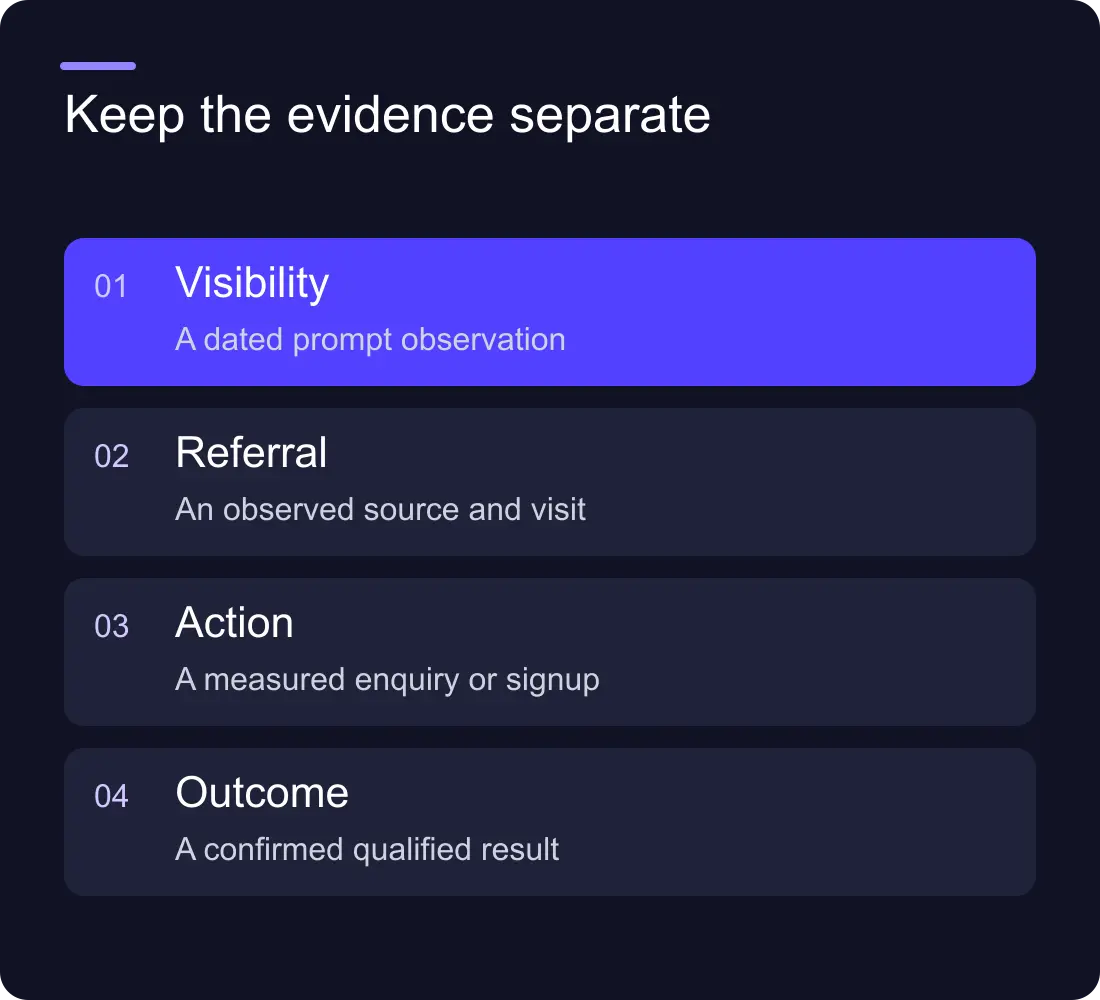
Measure AI search traffic in three separate layers: observed referrals, on-site actions and qualified commercial outcomes. Keep visibility checks separate from those layers. Being mentioned in an AI answer is not the same as receiving a visit, and receiving a visit is not the same as winning a customer.
There is no single report that reveals every AI-influenced journey. A useful measurement system combines observable analytics with clearly labelled limitations rather than turning every unattributed enquiry into an AI success story.
Distinguish visibility from traffic
A visibility check asks whether a particular system mentions or cites your business for a particular prompt. A traffic report asks whether someone reached your site through an observable referral. These are different measurements.
Record the prompt, system, date, relevant market and observed answer for a visibility check. Do not treat a single result as stable coverage across all users. Responses can vary, and the test itself does not establish audience demand or a commercial outcome.
For traffic, record the source information actually received by your analytics setup. Some journeys expose a recognisable referral. Others may not. A missing referral is missing evidence, not permission to assign the visit to the channel you want to prove.
Use session acquisition for observed visits
In GA4, first-user and session acquisition dimensions answer different questions. Google's acquisition guidance explains that distinction. Use the session view when asking which observable source brought a particular visit.
Inspect source and medium values before creating an AI referral group. Include domains you have actually observed and checked. Keep the rules documented so another person can understand what the report includes.
Do not rewrite every referral containing a familiar company name as AI search. A vendor can send traffic from several products or pages. Verify the source context where possible and label ambiguous traffic honestly.
Keep Google search reporting separate
Google's AI features guidance explains how its search AI features relate to ordinary search practices and reporting. Do not assume a Google organic visit can be individually labelled as an AI Overview visit in your analytics.
Use Search Console to review search visibility and clicks, and GA4 to review observable on-site behaviour. Google's Search Console and Analytics comparison explains why the reports serve different purposes.
If a dashboard presents an exact AI contribution without exposing its method, ask what was directly measured and what was estimated. Precision in a chart does not remove uncertainty in the underlying attribution.
Build a three-layer scorecard
| Layer | Observable information | What it cannot establish alone |
|---|---|---|
| Referral | Sessions with a verified source rule | Every AI-influenced visit |
| Action | Useful reading, enquiry or signup events | Whether the lead is suitable |
| Outcome | Qualified enquiry, opportunity or sale | The complete influence of earlier touchpoints |
Keep each layer visible. A small referral audience might produce useful enquiries. A large referral audience might produce little commercial value. Combining everything into one visibility score hides that difference.
Use consistent date ranges and explain any change to tracking rules. Otherwise an apparent improvement may simply reflect a new domain being added to the report.
A worked example without invented revenue
Imagine a fictional consultancy sees visits from a recognisable AI referral source. Some read a migration guide, and one submits an enquiry. The form records the article landing page where the measurement setup supports that connection.
The consultancy can report an observed referral and an enquiry associated with that journey. It still needs the sales team to confirm whether the enquiry is qualified. It cannot claim that every direct enquiry in the same week was caused by the guide appearing in AI answers.
This example contains no performance figures because the point is the evidence chain. Each claim should stop at the strongest evidence the business actually has.
Add self-reported information carefully
An optional “How did you hear about us?” field can reveal influence that referral data misses. Keep the answer alongside the observed analytics rather than using it to overwrite the technical source.
A person may mention a colleague, an AI assistant and a previous search in the same journey. That is useful context. It is not a reason to force the lead into a single perfectly certain category.
Make sure the form remains easy to use and that the information has an owner. A field nobody reviews creates friction without improving the business's understanding.
Connect content review to the evidence
Review the pages receiving observed referrals. Do they answer the question clearly, explain the limits and offer a sensible next step? Improve the page for the visitor, not just the dashboard.
Use AEO and SEO together: clear answers, useful examples, accessible text and meaningful links. Google's guidance does not require special AI schema. Structured data should describe visible content accurately rather than pretend to guarantee inclusion.
Compare enquiries with the page's intended audience. If the guide attracts unsuitable requests, sharpen the scope and explain who it is for. More traffic is not automatically a better content outcome.
Keep a monthly evidence note
Record observed sources, meaningful actions, qualified outcomes, visibility test observations and known measurement gaps. Include changes to consent, events, filters or forms that affect interpretation.
Ask whether the content is helping suitable people make progress. That question supports a better editorial decision than chasing an isolated count of AI mentions.
If you need the underlying site and measurement journey reviewed together, our SEO and CRO work connects discoverability with the experience after someone arrives.
Frequently asked questions
Can GA4 measure all traffic influenced by AI search?
No. GA4 can report source information received by the tracking setup and the on-site events it measures. Some AI-influenced journeys do not expose a recognisable referral, so the report is incomplete.
Is an AI mention the same as an AI referral?
No. A mention or citation is a visibility observation. A referral is an observed visit. Neither alone proves a qualified lead or sale.
Should we classify direct traffic as AI traffic?
No. Direct or otherwise unattributed traffic does not provide enough evidence for that assignment. Keep the uncertainty visible and use optional self-reported information as additional context.
Does special schema guarantee AI search visibility?
No. Use accurate structured data that matches visible content and follow ordinary search requirements. Clear answers and useful original material can support understanding, but they do not guarantee AI citations or rankings.