Webflow Localization suits markets that share a design system, content structure and publishing team. Separate sites suit markets that genuinely need independent ownership, products or release schedules. The useful question is not how many languages you need. It is how much of the website each market must control.
Translating an English homepage is a small part of the decision. A regional team may need different case studies, offers, legal copy, contact routes and campaign pages. Decide those responsibilities before choosing the site architecture.
Separate language needs from market needs
A language is a way to communicate. A market is a commercial context. Two countries can share a language and still require different information. One country can require several languages without needing several independent websites.
Write down what actually changes for each audience. Start with currency presentation, product availability, terminology, support hours, proof and who receives enquiries. Avoid collecting personal or legal requirements from a generic checklist: get the appropriate business owner to confirm them.
Then label each difference as shared content, adapted content or independent content. A translated explanation of the same product is shared in meaning. A region-specific customer story is adapted. A market with its own catalogue and sales process may be independent.
Compare the publishing responsibilities
| Decision | Shared site with locales | Separate sites |
|---|---|---|
| Global navigation change | Coordinated change across locales | Repeated implementation or shared code |
| Regional campaign | Managed within agreed local permissions | Owned within that regional site |
| Design system | Common source with local adaptation | Needs governance to avoid drift |
| Content retirement | Check all locale variants | Audit every site separately |
| Technical maintenance | One core implementation | Several implementations to maintain |
Neither option removes coordination. Separate sites move coordination into governance and maintenance. A shared site moves it into content models, permissions and release approval.
Use the table with the people who will actually publish. If the answer depends on an agency remembering which pages belong to which country, the operating model needs more work.
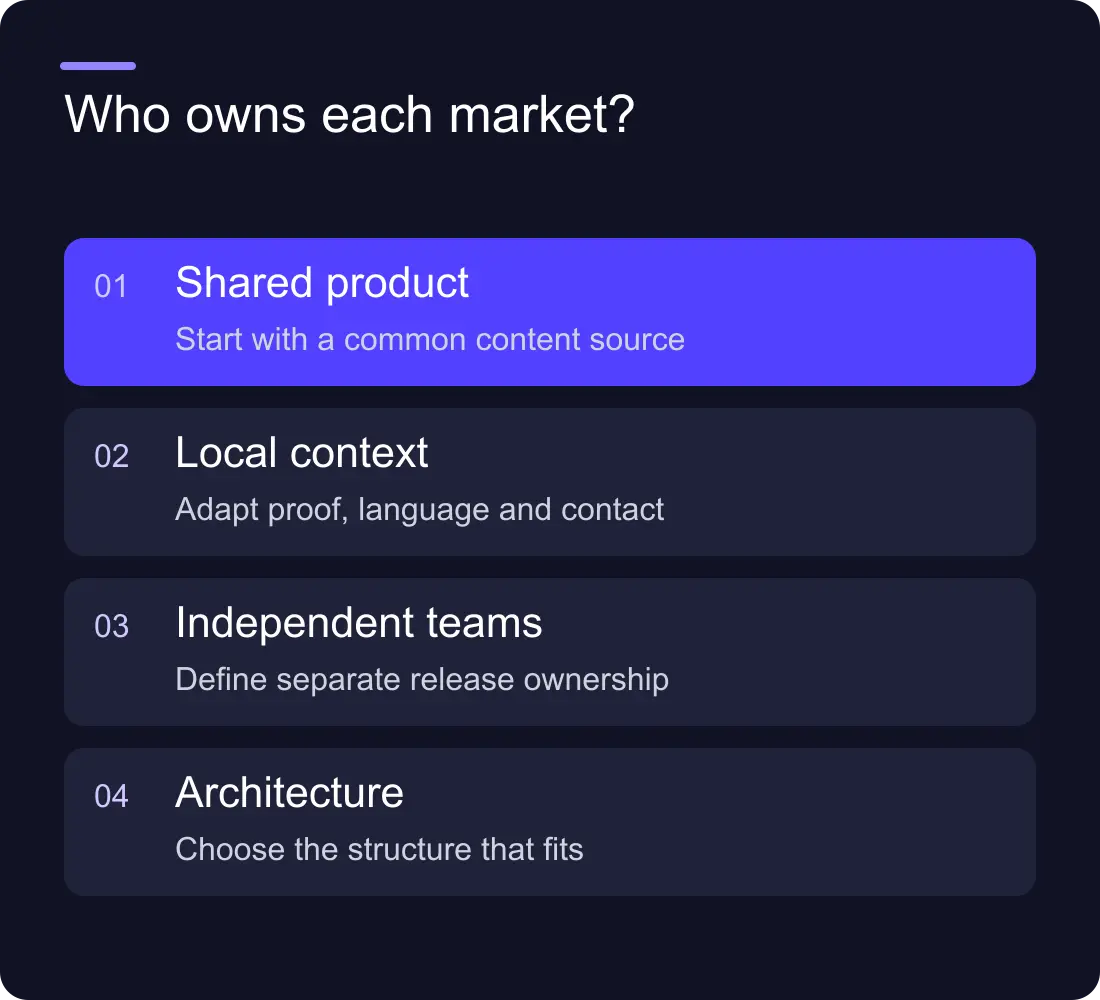
A worked example: one product, three commercial teams
Imagine a fictional B2B software business selling the same product in the UK, France and Germany. The product explanation and interface screenshots are shared. Customer stories, sales contacts and campaign priorities differ.
One localised site is a sensible starting point if the central team controls the design system and the regional teams can approve their own copy. It avoids rebuilding the same product pages three times. A regional launch checklist can still protect local ownership.
Now change the example: the German business is a separate brand with different products, contracts and a different team releasing weekly. A shared locale structure could turn every routine update into negotiation. Separate sites may be easier to run, even though they cost more to maintain.
The deciding factor is the second team's independence, not the presence of German text.
Define the content contract before translation
For each important page type, specify required fields and what a regional editor can change. A case study might share its industry classification but have a local title, excerpt and sales contact. A product page may share feature names while allowing a region-specific availability note.
Give every field an owner. Record whether a missing translation blocks publication, falls back to the primary locale or removes a section. A fallback is an editorial choice, not an excuse to hide unfinished work from the launch team.
Test long headings, different button lengths and translated navigation on small screens. Design for actual translated copy rather than assuming every phrase occupies the same space as English. A layout that only works with the original headline is not ready for localisation.
Webflow's locale management documentation explains its current locale controls. Confirm the features and permissions your proposed plan supports before building the workflow around them.
Treat international SEO as a publishing responsibility
Every important regional page needs a stable URL, a clear canonical decision and accurate language or region signals. Google documents localised versions and hreflang, including reciprocal references between equivalents.
Do not point every language version to the English page as its canonical just because English is the original. Decide which URLs should be indexed, and check the rendered output for the actual implementation. A translation plugin being installed is not proof that the page signals are correct.
Keep a map of equivalent pages. If a regional page is retired, decide whether there is a useful replacement in that locale. Sending every removed URL to a generic global homepage can leave visitors without the information they expected.
Plan a regional launch rehearsal
Use one complete visitor journey per market. Start at a local search result or campaign URL, move through the product explanation, view relevant proof and submit an enquiry. Check the confirmation message and the team receiving the submission.
Include the awkward cases: an unavailable product, a missing regional case study, a visitor changing language halfway through and a shared page updated just before a regional campaign launches. These reveal the rules the team needs to agree.
Give one person responsibility for confirming the release is complete. Several people may approve parts of it, but an unowned final decision is a common source of unfinished translations reaching production.
Questions to settle before choosing an architecture
- Which pages must remain identical in meaning across markets?
- Which team approves local changes, and how quickly?
- Can regional campaigns launch without changing global navigation?
- Who fixes broken links and outdated translations after launch?
- What would make a region need its own website later?
Record those answers in a website design brief. If the current site also needs a structural move, combine the regional plan with a migration checklist so content ownership and URL preservation are handled together.
Frequently asked questions
Is Webflow Localization the same as creating separate websites?
No. Localisation manages language and regional variants within a shared site structure. Separate websites have their own implementations and publishing responsibilities. Choose based on how independently the regional teams need to operate.
Should every country have its own website?
No. Separate sites can be useful when products, brands or ownership differ substantially. When the product and design system are shared, a localised site may be easier to maintain. Country count alone is not enough to decide.
Can translated pages rank in Google?
Translated pages can be indexed when they are accessible and have appropriate page signals. Ranking still depends on relevance, quality and competition. Translation and hreflang do not guarantee search visibility.
What should we test before launching a new locale?
Test the complete local visitor journey, translated layouts, equivalent page URLs, canonical and hreflang output, forms and the regional handoff. Also test what visitors see when a translation or regional resource is unavailable.