The useful question in an n8n vs Zapier comparison is not which tool has the longest feature list. It is which one your team can run confidently when a real enquiry arrives, a CRM is unavailable or the same form gets submitted twice.
For lead routing, start with the workflow and its owner. Zapier can suit teams that want a managed tool and familiar app connections. n8n can suit teams that need more control over branching, data handling or hosting and have the technical support to maintain it. Either choice still needs a tested failure path.
The workflow below is an illustrative evaluation plan, not a published benchmark or a claim about measured results from two live implementations.
Define one workflow both tools must complete
Use the same input and business rules for both candidates. Otherwise, you may compare a polished Zap with an unfinished n8n prototype and mistake implementation quality for a platform advantage.
Consider a fictional B2B website with this routing brief:
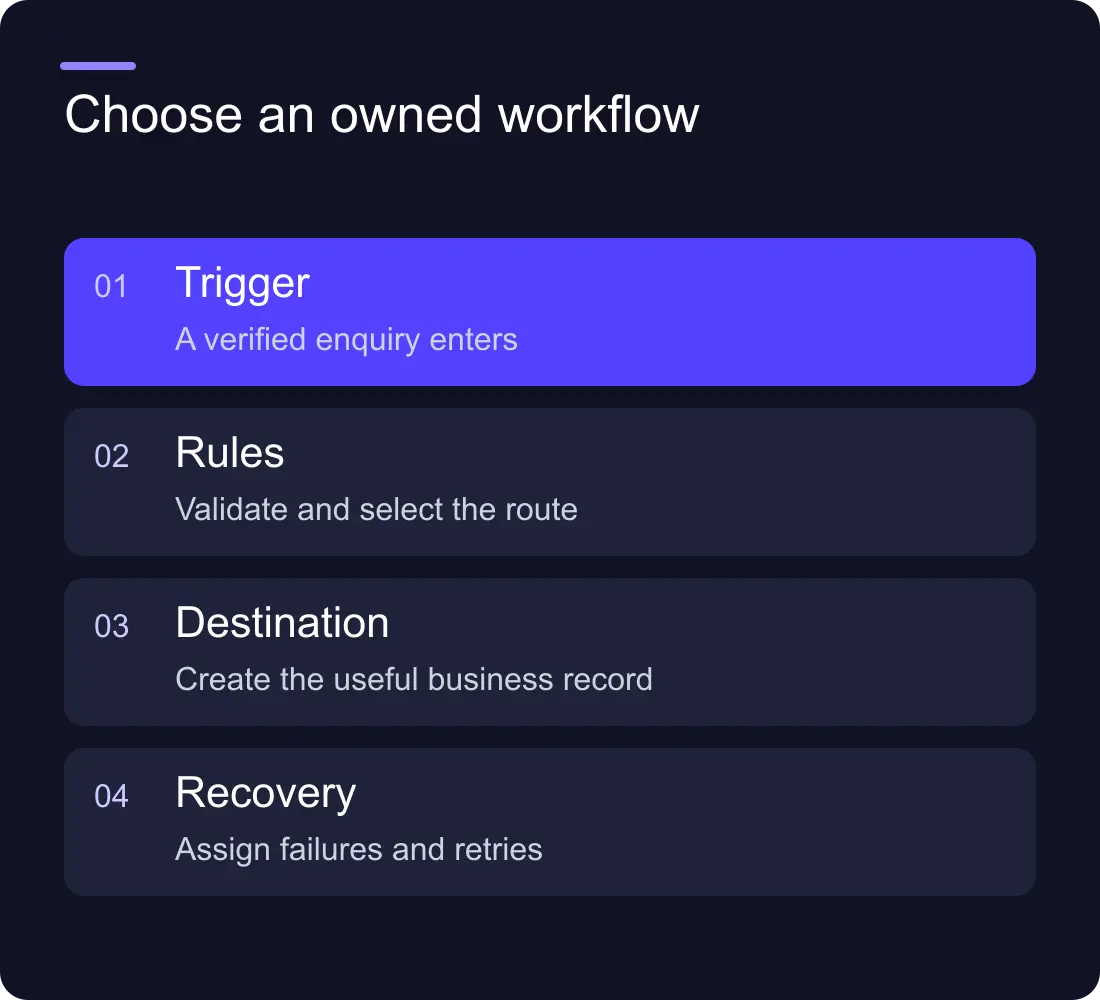
- Receive a form submission with name, email, company and enquiry type.
- Validate required fields and normalise the email address.
- Check for an existing contact and submission identifier.
- Create or update the CRM record.
- Assign an owner according to the enquiry type.
- Notify the owner with a link to the record.
- Record success or send the submission to a recovery queue.
Keep marketing subscription choices separate from the enquiry. A person asking for a quote has not necessarily asked to join your mailing list. Store only the fields the workflow needs and agree how long execution data should remain available.
Compare how the team will edit the rules
Give the person who will maintain the workflow a small change to make: route a new enquiry type to a different owner. Observe whether they can identify the relevant step, test it and explain the fallback.
In a managed automation tool, convenience often comes from the existing connectors and interface. In a more technical workflow, flexibility may come from expressions, code steps and direct API requests. Those are useful capabilities only if someone can maintain the implementation after the original builder leaves.
Ask who owns the accounts, credentials, source documentation and billing. A workflow built in a freelancer's personal workspace is an ownership problem regardless of how easy the editor looks.
Calculate costs using the right billing units
The vendors measure usage differently. n8n's pricing page describes workflow-execution billing. Zapier's pricing page explains task-based usage and plan allowances. Verify which steps count for the exact services and plan you are evaluating; do not multiply every box in a diagram and assume it is billable.
Build a dated cost worksheet with expected monthly submissions, counted actions or executions per submission, retry assumptions, plan allowance, overage rules and external service charges. Include hosting and support if you are evaluating self-hosted n8n. A community software option can still involve infrastructure, backups, updates and engineering time.
For an illustrative planning scenario, use 500 enquiries a month and list the normal path, duplicate path and failure path separately. Leave the vendor cost cells blank until you have checked current plan rules. This makes the comparison reproducible without presenting hypothetical bills as measured evidence.
Test failures before choosing the platform
A successful demo with one perfect submission proves very little about reliability. Create synthetic test cases with fake customer details and a clear expected result.
| Test case | Expected business outcome |
|---|---|
| Valid new enquiry | One CRM record and one responsible owner |
| Repeated submission ID | No duplicate record or repeated notification |
| Missing enquiry type | Default queue with an obvious reason |
| CRM request fails | Submission preserved and owner alerted |
| Notification fails after CRM success | Existing record retained; only notification retried |
| New enquiry type | Documented default until a rule is approved |
The last two cases are easy to overlook. Replaying the whole workflow after a late failure can create duplicate work. Use an idempotency key or another explicit duplicate-control design, and know which step can be retried safely.
Record actual results, settings and versions when you run the tests. Do not award a platform a reliability score based on documentation alone. n8n's error-handling documentation is a useful starting point for its error-workflow approach; you still need to configure and test your own recovery process.
Decide on operations, not just the first build
Choose Zapier when its connectors cover the required services, the team can manage the rules and the cost model remains acceptable at realistic volume. Check that the relevant apps, features and access controls are available on the selected plan.
Choose n8n when the workflow benefits from its control and the team can support the implementation. If you self-host, name the person responsible for upgrades, infrastructure, credentials and recovery. If you use n8n Cloud, distinguish vendor hosting responsibilities from the logic your team owns.
Keep a manual fallback. If the automation is paused, someone should still be able to retrieve the enquiry and respond. Document where unprocessed submissions live, how alerts arrive and who checks the queue.
Hand over something another person can run
A useful handover contains the input schema, routing rules, duplicate strategy, test cases, account ownership, failure alerts and a short recovery procedure. Include the last date prices and integrations were reviewed.
This is where a platform comparison becomes a business decision. The cheaper subscription can be the more expensive choice if the team cannot repair a failed route. The more flexible tool can be unnecessary if the workflow is simple and changes rarely.
Is n8n always cheaper than Zapier?
No. Compare the current billing rules for your actual workflow and include implementation, hosting where applicable and support. The number of visible steps is not a reliable cost comparison by itself.
Do we need AI for lead routing?
Not usually for clear rules such as region or enquiry type. AI may help interpret free-text requests, but uncertain classifications need an explicit fallback. Keep deterministic rules where they already solve the problem.
Explore Hilvy's Zapier work, Make integrations or the Webflow form automation guide for the wider implementation decisions.