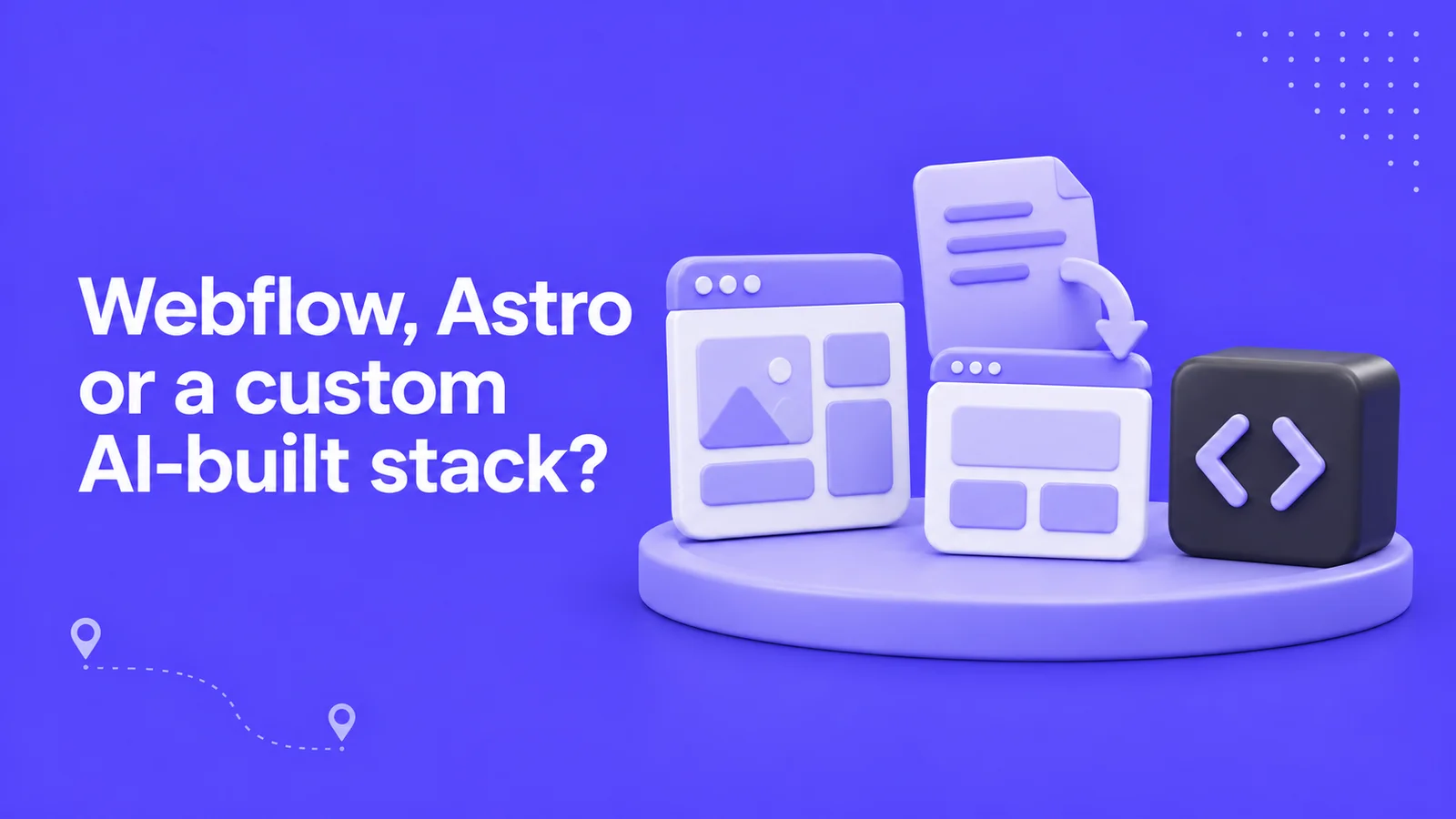
Webflow, Astro and an “AI-generated stack” are often presented as three competing ways to build a website. They are not quite the same kind of thing.
Webflow is a platform. Astro is a framework. AI-generated describes how some of the code was produced. You can use AI while working with either Webflow or Astro, and a generated application still depends on an actual framework, database and operating setup.
A better choice starts with the work the website needs to do and the people responsible for changing it after launch. The most impressive demo is not always the most suitable handoff.
Start with three ownership questions
- Who will change content and create pages every week?
- Which parts of the experience need custom behaviour or business logic?
- Who will maintain the implementation, hosting and integrations?
Write down the answers with the client. “The team will manage it” is not precise enough if nobody has agreed whether that means editing a CMS, using a visual canvas or maintaining a repository.
Then test a representative task. Ask the future editor to update a case study or prepare a campaign page in the proposed workflow. A platform decision becomes clearer when it includes the person who will live with it.
Choose Webflow when visual website ownership matters
Webflow is worth considering for a brand or marketing website where visual editing and a structured content workflow are important. Its CMS combines content collections with visual page management, so the editing experience can be part of the website delivery rather than a separate application project.
A practical fit might be a service business publishing projects, landing pages and editorial content with regular input from designers and marketers. The build should provide reusable sections and sensible constraints, not simply a collection of individually styled pages.
Before choosing it, test the difficult requirements: content relationships, localisation, integrations, user accounts and any unusual interaction. Verify the current plan and feature requirements directly. A platform can be a good fit overall and still need a separate service for a particular capability.
Our Webflow agency service focuses on a site the team can keep improving, not just the launch-day design.
Choose Astro when a custom, content-led build fits the team
Astro is designed around content-driven websites. Its islands architecture lets a site use interactive components selectively while much of the page remains rendered HTML.
That can be a useful foundation for an editorial site, a detailed services website or a custom brand experience. It does not automatically guarantee a fast site or better rankings. Large images, unnecessary scripts and poor content decisions can undermine any architecture.
The editorial interface needs a separate decision. Content might live in a CMS such as Sanity or in version-controlled files, depending on the people using it. Astro itself should not be confused with a complete visual editing environment.
The trade-off is ownership of the implementation. Someone needs to maintain the repository, integrations and deployment process. Our Astro development and Sanity development services can be combined when a custom frontend and structured editorial workflow make sense.
Choose a custom application when the behaviour is the product
If the core experience involves accounts, permissions, calculations, collaborative workflows or a substantial operational process, treat it as an application decision rather than a website-builder contest.
AI tools can help prototype and implement that application. They do not remove the need to decide how authentication, data access, billing, background work and recovery function.
Ask for the actual stack by name and an explanation of why it was selected. Can another developer run it? Are dependencies maintained? Can the organisation retrieve its data? Who handles a failed integration on a busy day?
A prototype can remain disposable while you learn. Once real customers or sensitive data depend on it, apply production guardrails and review the risks explicitly.

Do not force every part into the same tool
A marketing website and a customer application may have different needs. They can share a brand system and a coherent user journey without sharing every implementation detail.
For example, a business could use a visually managed marketing site and a separately engineered customer portal. That separation creates integration and account-boundary work, so it should be a deliberate choice, not an accidental collection of tools.
Likewise, an Astro site can contain interactive features without becoming a full client-side application. Choose the smallest coherent setup that meets the requirements, not the smallest number of product logos on an architecture slide.
Compare the next year, not just the first week
List the recurring costs and responsibilities: platform plans, hosting, CMS access, third-party services, monitoring, updates and support. Include the effort required for ordinary content changes.
For an existing site, include the migration work too. Preserve valuable URLs, map redirects where needed, move content carefully and check measurement after launch. A rebuild should not casually discard search equity or a working editorial process.
Source by Webflow is also worth watching, but it remains a research preview at the time of writing. Our Source overview separates the announcement from decisions you can responsibly make today.
The short answer
Consider Webflow when a visually managed marketing website fits the team. Consider Astro when a custom content-led implementation and ongoing developer ownership make sense. Choose a deliberate application architecture when complex behaviour is the product, whether or not AI helps write it.
If you are unsure, start with the intended editing workflow and one difficult requirement. We can work through those in a project conversation, then recommend the build and hosting arrangements around the people who will use them.