The familiar website-builder question is “How quickly can I create a page?” The more interesting question behind Source by Webflow is “How do different people and agents keep changing the same website without losing control of it?”
That is a different problem. It involves the relationship between the codebase, content, design decisions and the tools a marketing team uses after launch.
As of 6 September 2026, Source by Webflow is a limited research preview with phased access. This article is an interpretation of the announced direction, not a hands-on review or a claim that the product is generally available.
What Webflow is describing
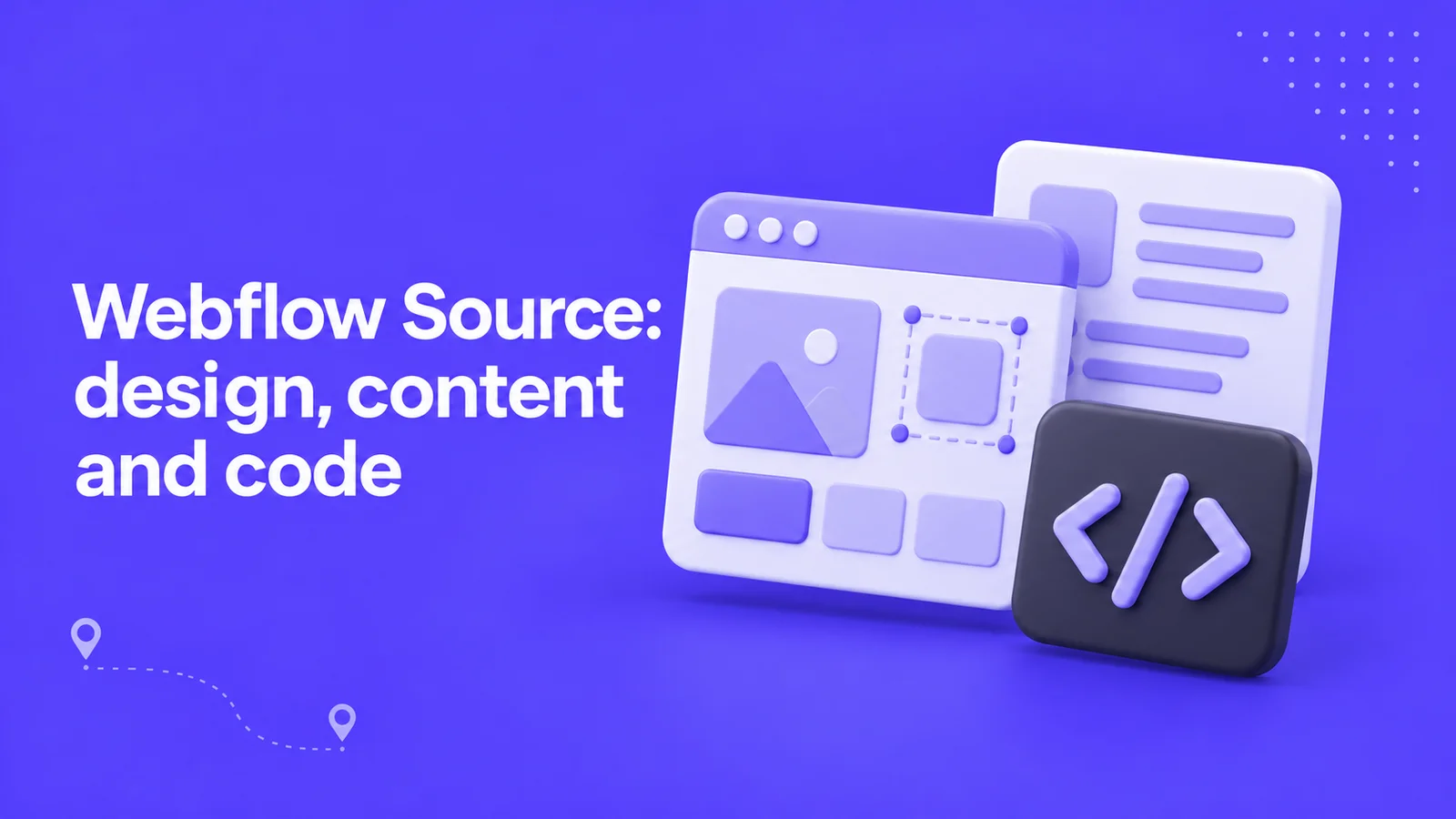
Webflow presents Source as an agentic marketing platform connecting code, content and tools in a shared environment. Its announcement describes tailored workspaces for different roles, with permissions and review around changes.
The important point is not simply that AI can generate a page. It is the proposed connection between people editing visually, developers working with code and agents carrying out tasks against a shared foundation. Those are Webflow’s announced ambitions for Source, not a verified result from a client project.
Our reading is that the platform is aiming at the coordination problem around a website. The success of that approach will depend on how well the boundaries, reviews and everyday workflows work in practice.
Why that problem matters
Consider an ordinary campaign update. A marketer changes the offer, a designer adjusts the layout and a developer adds an integration. An agent might draft copy or implement a component along the way.
If each participant works from a different version of the truth, speed creates more opportunities for disagreement. The approved message is in one document. The actual component behaves differently. A generated change silently introduces a new pattern.
A shared workspace could make those relationships easier to understand. But it still needs someone to define the design system, the content responsibilities and which changes require approval. A platform cannot decide the organisation’s priorities on its behalf.
The useful distinction: generation versus operation
Generation produces something new. Operation is what happens when people rely on it. A campaign page needs an owner, a publishing process, working measurement and a way to undo a bad change.
This is why “another website builder” feels too narrow a description of the announced direction. The relevant evaluation is not only how impressive the first generated page looks. It is whether the tenth update remains understandable and safe.
For an agency, the work shifts towards defining the reusable system and the boundaries around it. Brand judgement, content structure and technical review do not disappear because a tool can carry out more of the implementation.
What we would test in a pilot
A sensible pilot starts with a contained workflow and non-production content. Choose a task the team already understands, such as creating a landing page from approved components.
- Context: does the workflow use the actual components and content model, or create a parallel version?
- Permissions: can each role do what it needs without gaining unnecessary publishing or data access?
- Review: can a reviewer see what changed and understand the consequences?
- Recovery: is there a clear way to undo a change, including effects outside the page itself?
- Maintenance: can someone other than the original builder continue the work?
Record the complete effort, including setup and review. A quick first draft is useful evidence, but it is only part of the operating cost. Keep the pilot reversible until the requirements and available capabilities match.

What this means for an existing Webflow website
Webflow says it will continue investing in its existing product and describes a supported path for customers who later choose to move to Source. That is not a reason to assume an immediate migration is required.
If your current website serves the business and the team can maintain it, protect that value. Fix the actual limitations: unclear templates, inconsistent components, missing integrations or a difficult publishing workflow.
If a redesign is already planned, keep the content model and design decisions well documented. Those are useful assets regardless of the eventual platform. Avoid postponing necessary improvements indefinitely for a preview product whose fit has not been established.
Questions still worth asking
Before committing a client project, confirm current access, supported integrations, commercial terms, data handling, export options and support expectations directly with the provider. Do not infer those details from a product demonstration.
Ask who will own the code, content and operating accounts. Ask what happens if the agency relationship changes. These are ordinary procurement questions, and they remain relevant in an agentic workflow.
Our Webflow agency work starts with what the team needs now. Source is a direction to evaluate carefully, not a reason to declare the current platform obsolete. For the broader choice, read when to use Webflow, Astro or an AI-generated stack.