An AI agent and a chatbot can look identical to a website visitor. Both may sit inside a chat window. The important difference is what happens behind that window: answering a question is one responsibility; deciding to use tools and change business records is another.
For website leads, choose the smallest system that can complete the job reliably. You may need a better FAQ, a chatbot with approved answers, a fixed automation or a carefully limited agent. A more autonomous system is not automatically a better customer experience.
Understand the interface and the permissions
A chatbot is a conversational interface. It can follow scripted branches, generate answers from supplied information or pass a request to someone else. Some chatbots also call tools, so the label alone does not tell you what a product can do.
An agent typically uses a model to choose actions within a goal and a set of permissions. It might decide to look up a record, ask for a missing field and use a tool to prepare a handoff. n8n's agent documentation describes model-directed tool use; Anthropic's architecture guide distinguishes fixed workflows from systems that direct their own process.
Ask vendors to demonstrate the actual behaviour rather than relying on the name. Which decisions are fixed? Which does the model make? What information can it read, and what can it change?
Match the system to the lead's next step
If visitors repeatedly ask whether you offer a service, a clear page or answer-based chatbot may be enough. If the task is to copy form data into a CRM and assign a regional owner, a fixed automation may be easier to test.
An agent may be useful when requests vary and the system must choose between several tools or information sources. For example, an illustrative lead assistant might gather missing brief details, find the relevant service information and prepare a summary for the team. That does not require giving it permission to send a quote or promise a delivery date.
| Need | Start by evaluating |
|---|---|
| Answer common service questions | Clear content or a bounded chatbot |
| Route a form using known rules | Deterministic workflow |
| Gather missing information in conversation | Structured conversational flow |
| Select tools for varied requests | Limited agent with explicit boundaries |
| Negotiate bespoke terms | A responsible person |
Write the boundary before connecting tools
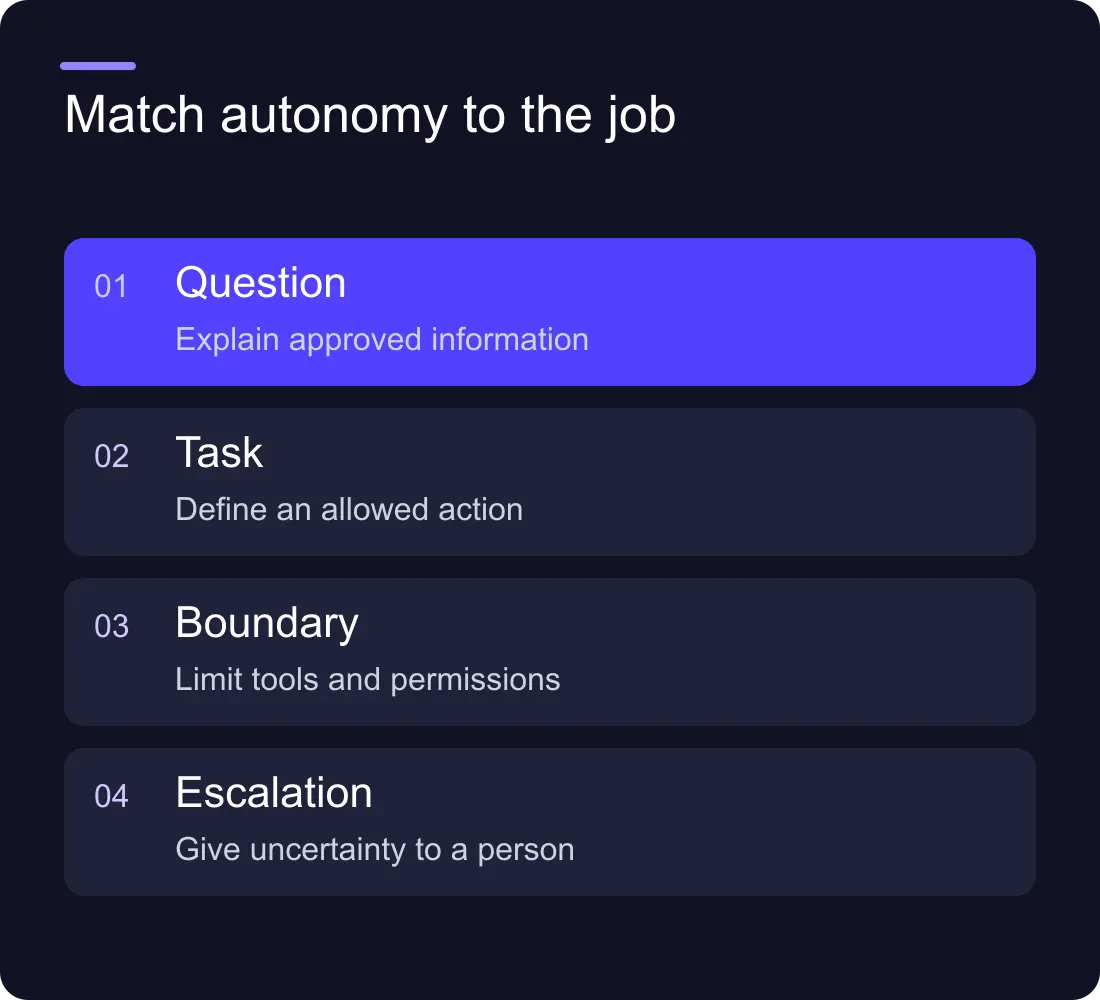
List what the system can read, what it can write and what requires human approval. Keep account permissions aligned with that list. A prompt that says “do not change anything important” is weaker than a tool that cannot perform the change.
For a lead assistant, consider separating draft creation from external action. The system can prepare a CRM note while a person approves the classification or response. Give each write an identifier and a record of what happened so repeated tool calls do not create duplicates.
Decide what happens when the visitor asks the system to ignore its instructions or retrieve private information. Treat conversation text as input, not as permission to expand the assistant's access.
Test the whole journey
Create a test set using synthetic details. Include a straightforward enquiry, an ambiguous request, incomplete contact information, an unsupported service and a tool failure. Write the expected outcome before running the test.
Check the visitor's experience as well as the model's answer. Can they request a person? Can they leave without sharing unnecessary information? Does the responsible team receive the context? If the CRM is unavailable, is the request preserved?
Measure correct handoffs, missing information, inappropriate actions and recovery, not just fluent responses. A well-written answer can still be operationally wrong if it assigns the lead to nobody.
Calculate the cost of owning the system
Include model usage, the chat or workflow platform, integration work, monitoring and content maintenance. Agentic tool use can involve several calls for one request, so estimate usage from the proposed journey rather than the number of visitors alone.
Compare this with the cost of a simpler alternative. A contact form with a few well-chosen fields may produce better briefs without a conversational layer. A fixed route may be more predictable than asking a model to interpret a category the visitor could select themselves.
Review sampled outcomes after launch and maintain the source information. Someone must own changes to services, team responsibilities and approved answers. This responsibility remains even when the software provider manages hosting.
Can a chatbot also be an AI agent?
Yes. A chat interface can front an agent. Evaluate its tools, decisions and permissions rather than assuming a neat division based on the product label.
Should an agent qualify every lead automatically?
Use it to support a defined process, with review where mistakes matter. Avoid rejecting a prospect solely because a model inferred their budget, urgency or suitability from an incomplete message.
Read the Webflow chatbot handoff guide, the n8n vs Zapier comparison or explore Hilvy's AI capabilities.