Brand identity and visual identity often appear as interchangeable items in a website proposal. They are related, but the distinction matters when you compare scope. A set of colours and logo files does not necessarily explain what the business stands for, who it serves or how it should speak.
For a website project, ask which strategic, verbal and visual decisions are already settled. Then ask what the design team must create. This prevents a missing brand brief from appearing halfway through a build as unexpected copy and strategy work.
Understand the wider identity
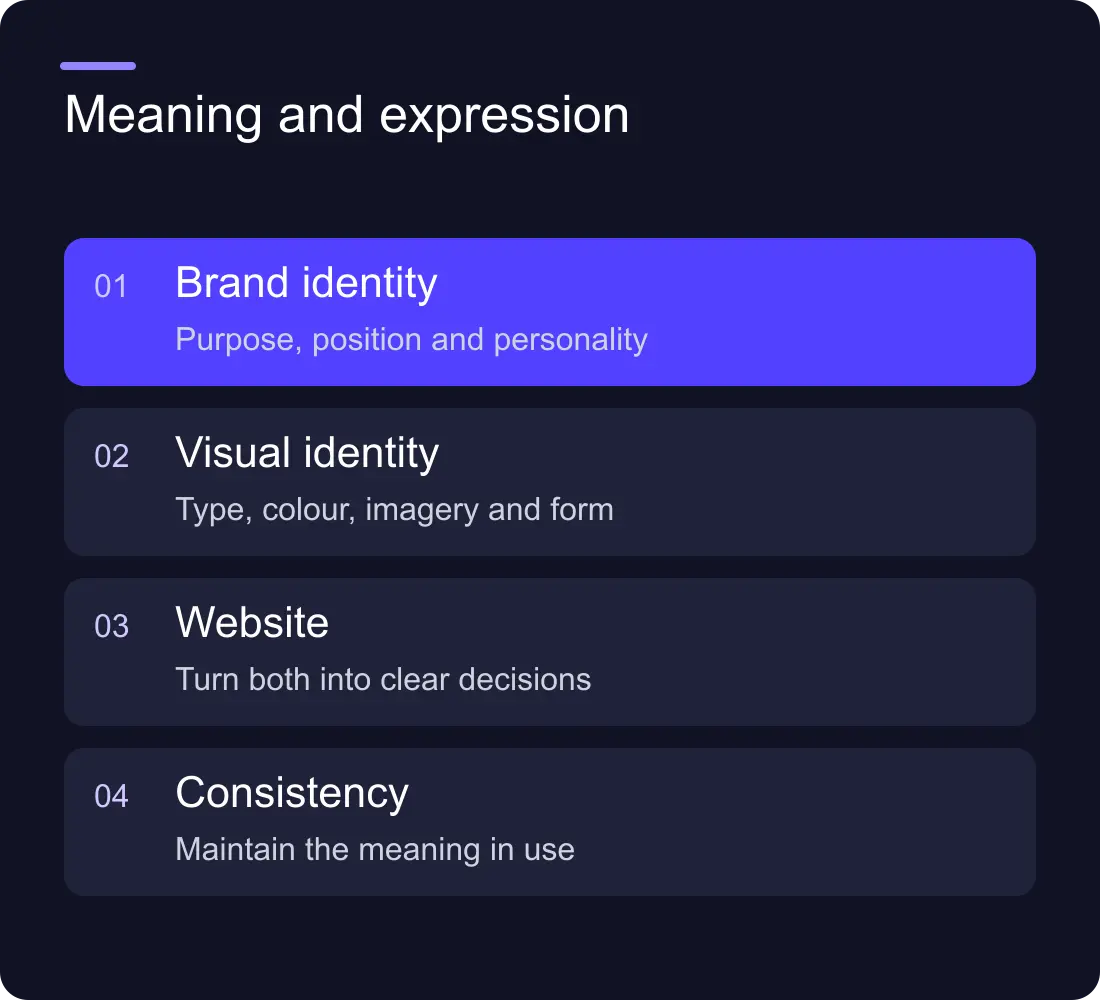
Brand identity describes the intended character and expression of the business. Depending on the project, the work can include positioning, audience, proposition, personality, verbal language and visual rules. Different studios package these differently, so read the deliverables rather than assuming a universal definition.
Visual identity is the visible system: logo, typography, colour, image direction, layout principles and other recognisable elements. It gives the business a coherent appearance, but it does not automatically resolve the underlying offer or messaging.
A useful website needs both clear meaning and coherent expression. Beautiful typography cannot make an unclear service easy to buy; sound positioning can still be undermined by inconsistent layouts and imagery.
Audit what the website team actually receives
Create three lists: available, needs review and missing. Put the proposition, audience, service names, tone, logo assets and usage rules into the appropriate columns. Include the date and owner of existing guidelines.
Look for contradictions. A brand deck might describe enterprise buyers while the site copy speaks to solo founders. A visual system might use colours that work in print but make interface text difficult to read. A logo might exist only as a low-resolution image.
These are practical handover issues. Resolve them before treating the website as a simple application of an existing identity.
Define the verbal work
The site needs a recognisable way to explain the business, not merely a list of approved adjectives. Give the team a clear description of the offer, the audience's questions and examples of language that fit.
Decide who writes service copy, project stories, form messages and metadata. A visual-identity package may not include those. “Apply the brand” can otherwise become an undefined request to rewrite the entire business proposition.
Use specific claims the company can support. If the identity calls for confidence, that does not justify guaranteed results or invented client evidence. Tone should change the way you express the truth, not the truth itself.
Turn the visual identity into a digital system
For websites, ask how the identity works in headings, body copy, buttons, forms, cards and CMS templates. Check the smallest screen as well as the presentation slide. A visual rule that depends on very large type may need an equivalent for compact interfaces.
Define accessible colour combinations, image treatments, spacing principles and component examples. Include both an expressive marketing page and an ordinary content page. The site will eventually need a contact form or a long guide, not only a dramatic homepage.
Keep the rules usable for editors. A project template can explain the permitted image formats and content fields. That is more durable than expecting every new CMS item to be art-directed from scratch.
Compare proposals by decisions and usable outputs
Ask each provider what the team will know and own when the project finishes. A useful scope might include a positioning statement, verbal guidance, visual source files, digital usage examples and an implementation handover.
Clarify whether website copy, component design and development are included. Check rights, export formats and account access. A folder of attractive mockups is not the same deliverable as an identity the business can apply across its channels.
Use the creative agency vs branding agency guide to compare roles, and the brand refresh vs rebrand guide to decide the scale of change.
Can we commission visual identity without a full brand strategy?
Yes, when the audience, positioning and offer are clear enough to guide the work. Record those inputs and the limits of the scope. If the fundamentals are unresolved, a visual project may need strategy work before design can proceed usefully.
What should go in a website brand handover?
Include the offer and audience, verbal examples, approved assets, digital rules, source files, rights and unresolved decisions. Name the person who can approve how the identity is applied.
See Hilvy's design services, website work and the website brief template to turn the identity into a buildable plan.