A Webflow website cost is made up of several different bills: planning and build work, the platform, connected services and ongoing support. Putting those into one headline price can make two very different proposals look comparable.
For a useful budget, separate the one-off scope from the recurring operating costs. Then ask what the business owns and what the team will be able to manage after launch. This guide explains the cost structure without inventing a universal agency price.
Start with the website's job
A small marketing site, a content-heavy B2B website and an ecommerce store have different requirements. Page count is only a rough signal. A five-page site with complex integrations can involve more work than a larger site built from a simple shared template.
Write down the audience, main action, required content and functions. Include languages, forms, CRM routes, publishing needs and migration. Use the website brief template to make those inputs concrete before requesting quotes.
Ask providers to price the same brief. Otherwise, one proposal may include strategy and copy while another assumes you will supply both.
Separate planning, design and implementation
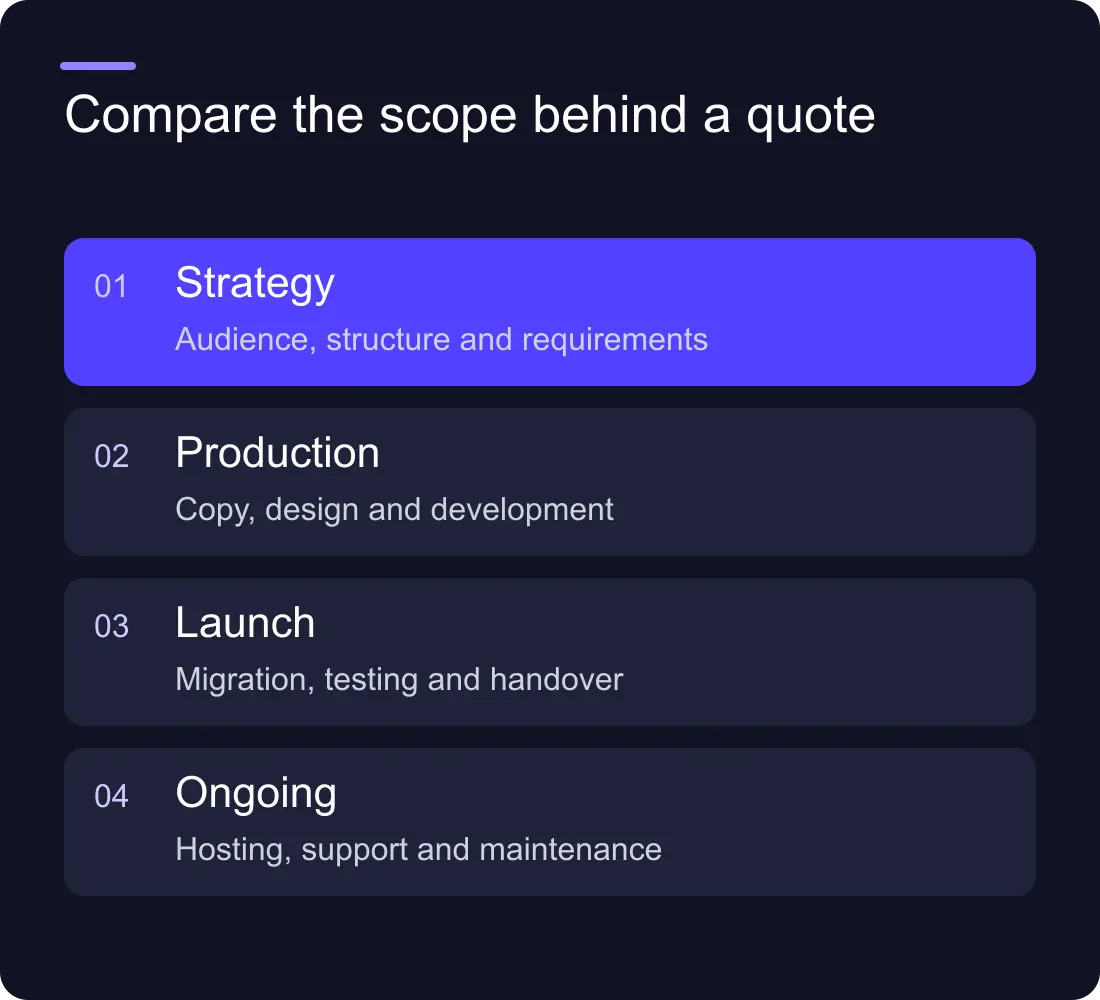
Planning can include page architecture, content decisions and technical scope. Design can include the visual system, responsive layouts and component behaviour. Implementation can include Webflow development, CMS collections, forms, integrations and publication.
Clarify which of those are included. “Custom Webflow website” does not establish who writes the copy, creates the brand assets or checks the launch. Ask what happens if the initial content or identity is not ready.
For a redesign, include the existing URL inventory, redirects and content transfer. These are real tasks even if they are less visible in a design presentation.
Read platform costs separately
Check Webflow's current pricing for the Site and Workspace options relevant to your team. Site hosting and team-workspace needs are related but distinct. Verify billing frequency, currency, tax, capacity and any add-ons when you make the decision.
Avoid using a screenshot of an old plan table as the budget. Pricing structures and product names can change. Keep a dated note of the selected plan and the requirements it meets.
List connected costs separately: domains, localisation, analytics, forms or CRM services, automation and chat. Not every site needs all of them. A subscription should have a job and an owner rather than being included because a template supports it.
Budget for content and migration
Content work includes more than pasting text into pages. It can involve rewriting service explanations, selecting images, gathering case-study information and reviewing metadata. Name the provider and approval process for each.
A migration may require moving CMS records, downloads, image references and old links. Ask whether the quote includes redirects, live-domain checks and post-launch monitoring. See the website redesign SEO guide for the questions to put into the scope.
If the business is changing its identity at the same time, define that work explicitly. A website designer cannot apply guidelines that are still being debated without affecting the schedule.
Define support after launch
Ongoing support can include content help, integration maintenance, release checks and incident handling. Platform hosting does not automatically include every change or problem in your website's configuration.
Ask for agreed response expectations, exclusions and a way to request work. A maintenance arrangement and a monthly growth programme serve different purposes; compare what each actually delivers.
Know who owns the domain, Webflow workspace, integrations and billing. The business should understand how another provider could take over and what documentation would be available.
Compare the first year, not only the build fee
Use this worksheet for each proposal:
- One-off planning, content, design and build.
- Migration, launch testing and training.
- Site and Workspace plans required.
- Third-party subscriptions and expected usage.
- Support scope and recurring fee.
- Optional work and likely change-request process.
- Account ownership and handover deliverables.
Separate confirmed prices from estimates and assumptions. A lower build fee can be reasonable if you supply more work, but that responsibility should be visible in the comparison.
Is a template always cheaper?
It can reduce some design or implementation work when it fits. Content, accessibility, integration and migration still need attention. Compare the complete scope rather than assuming the template price is the project price.
Why do Webflow agency quotes vary so much?
Providers may include different strategy, copy, design, technical work and support. Ask them to explain the deliverables and assumptions against the same brief before deciding that the higher quote is simply a markup.
Explore Hilvy's Webflow services, website work and maintenance, or read the wider business website cost guide.